In this precariousness already difficult to endure, a new blow struck the family. MAIGA Kadidja, Aicha's daughter, aged 33 months, began to waste away. Spotted on March 15, 2026 by a community health worker, then examined two days later at advanced health post 1 of the Djibo health district, the diagnosis came: severe acute malnutrition. Kadidja then weighed 10 kg 500 for a mid-upper arm circumference of 114 mm, figures that reflect a body at the end of its strength.
For Aicha, this news was too much. Between the exhaustion of a displaced person's life and the anguish of seeing her child ill, she sank into discouragement. She stopped attending follow-up appointments regularly. At home, she sometimes gave Kadidja a little porridge, but without the prescribed therapeutic food, perhaps thinking that would be enough, or no longer having the strength to believe in it.
Faced with Aicha's repeated absences and a weight that was not going back up, the health workers decided to go and meet her rather than wait. An IYCF counseling facilitator joined them for a home visit, conducted according to the EVISA approach. That day, something changed. Aicha herself speaks of a moment when she felt listened to and supported, rather than judged for her absences.
From there, everything turned around. Kadidja began following her treatment again, and her body responded. Week after week, her weight climbed: 400 grams, then 670, then 950 grams more over the last three weeks of her care. On August 25, 2026, she left the health center program cured, weighing 12 kg 100.
Aicha, for her part, did not only get her daughter back in good health. She has become an active presence in educational talks and cooking demonstrations on infant and young child feeding, the one who, today, can speak to other mothers about what she went through.
Kadidja has regained her strength, and her mother has regained hope!
À Djibo, région du Djelgodji dans le Sahel burkinabè, Boena Aicha n’a plus rien de ce qu’elle possédait à Baraboulé, son village situé à une trentaine de kilomètres au nord-ouest de la ville. Comme des milliers d’autres déplacés internes, elle a dû tout laisser derrière elle et s’installer au secteur 4 de la commune, où la famille ne survit que grâce à l’assistance alimentaire du PAM et du CONASUR.
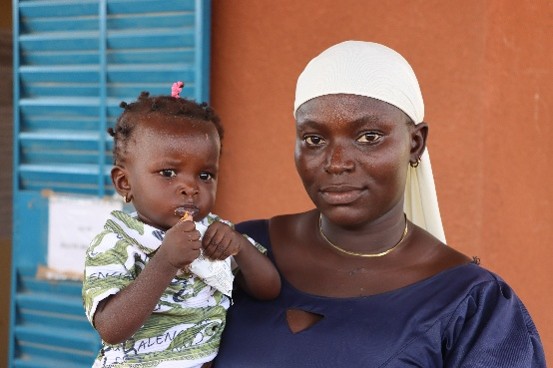
August 22, 2026, Soum Region, commune of Djibo, Burkina Faso. BOENA Aïcha holding her daughter MAIGA Kadidja while she eats PlumpyNut. Copyright @IRC Burkina Faso
As part of the project funded by SRF, BOENA Aïcha benefits from the "Brighter Future" approach implemented by IRC, which combines the health and child protection sectors.
Children take part in playful and educational activities while following the malnutrition treatment program, in order to stimulate their development and speed up their recovery. Mothers, for their part, receive advice and support to better manage their children's health.
Funded by the Sahel Regional Fund (SRF), this project implemented by IRC in partnership with AMMIE and CPOF (01/09/2025 – 30/05/2027) aims to sustainably strengthen the resilience of more than 65,000 people affected by the crisis in the Yaadga and Soum regions of Burkina Faso. Its ambition is to support populations at every stage: survive current crises, recover effectively after recurrent shocks, and then gain autonomy in the face of future crises, in order to gradually reduce their vulnerability and their dependence on humanitarian aid.
To achieve this, the project adopts a multisectoral approach that combines preventive health through vaccination, food security through livestock production and restocking, strengthened community protection, economic support through income-generating activities (IGAs) and savings groups, as well as tools adapted to the management of malnutrition.
